Saturday, April 6, 2013

Famous Danish People


Denmark has a few celebrities, but some of them are very recognized all over the world.

Is from Denmark one of the greatests writers on the XIX Century, Hans Christian Andersen. "The Princess and the Pea", "The Little Mermaid" or "The Emperor's New Clothes" are three of his more read tales.


There are also some actors and actresses from Denmark.


Mads Mikkelsen, who won the Best Actor Award playing the main antagonist Le Chiffre in the twenty-first James Bond film,Casino Royale.


Brigitte Nielsen, Is an actress, model, musician and reality television personality. She is also known for her marriage to Sylvester Stallone (1985-1987).

Sven-Ole Thorsen, is a Danish actor, bodybuilder and strongman competitor. In 1983 he won a prize, Denmark's Strongest Man.


Film Directors.

Susane Bier,


Jacob Christian Jacobsen was a Danish industrialist and philanthropist best known for founding the brewery Carlsberg. Starting in 1844, he established his brewery on the outskirts of Copenhagen, in 1875 he founded the Carlsberg Laboratory.


Viggo Mortensen is an American actor, poet, musician, photographer and painter. Eastern Promises (2007)made earn him an Academy Award nomination for Best Actor. Mortensen is also politically active. 


Karen von Blixen-Finecke was a Danish author also known by her nickname Isak Dinesen. Blixen is best known for Out of Africa, her account of living in Kenya and she has been really acclaimed. 


René Redzepi is a Danish chef and co-owner of the two-Michelin star restaurant Noma in the Christianshavn neighborhood of Copenhagen, Denmark. His restaurant was voted the best restaurant in the world in 2010 San Pellegrino Awards, 2011 and 2012.


Friday, April 5, 2013

NYHAVN – The harbor


NYHAVN – The harbor

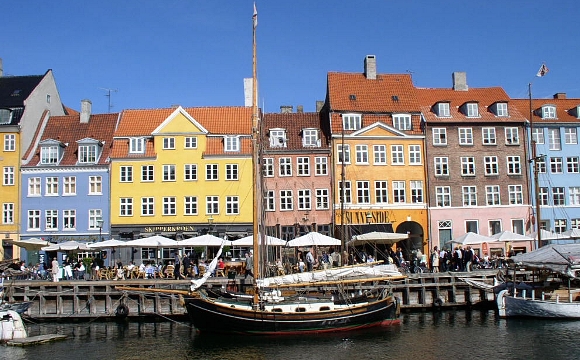
Nyhavn "New Port" was established by King Frederik V (1646-1699 - ruled Denmark and Norway 1670–99) in 1670-73 as a gateway from the sea to the old inner city and at that time the canal area reached right up to the Kongens Nytorv (Kings Square), where the ships unloaded their cargo and the fishermen their daily catch. The trade and shipping activities around Nyhavn provide a strong growth of Copenhagen and the many houses surrounding the Nyhavn canal along the two quays are more than 300 years old.

Mansions for the wealthy
In the beginning of the 1700s and on the shady side of Nyhavn, great mansions like Charlottenborg and other lavish houses with flats for the wealthy citizens were built. On the sunny side the houses were built of wood, brick and plaster and were the most colorful and picturesque house at Nyhavn rented by poor and common residents.

Old wooden ships
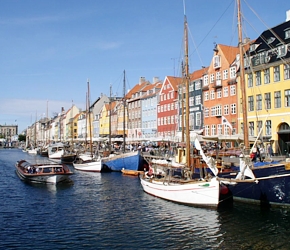
Up through the 1970s, Nyhavn has become a fashionable place to live and the quay is turned into a pedestrian street and the canal is packed with old wooden ships creating an atmosphere from the past time around 1780-1810 when Nyhavn was the main centre of all trade to sea from Copenhagen.
Every 30 min. there are boat tours from Nyhavn around the harbour area and canals to historical sights and known places.
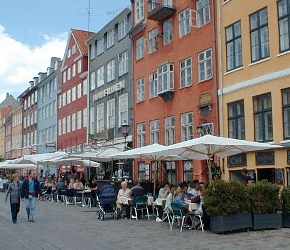
Restaurants and cafés alongside the quay overlooking the canal with its old wooden ships and special maritime atmosphere.

Picturesque old houses
Nyhavn with its picturesque old houses on either side of the canal offers a variety of restaurants, pubs, cafés with dancing and music - 24 hours a day. Nyhavn is also called "The longest outdoor bar in Scandinavia" - with its many restaurants and cafés overlooking the canal.

Hans Christian Andersen and Nyhavn
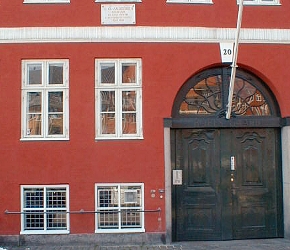
The famous fairy-tale writer Hans Christian Andersen lived in no. 20, from 1834-38, where he wrote his first stories. Later he also lived on the opposite - sunny side of Nyhavn in no. 67 - from 1845-64. The last years of his life he lived in no.18.

House no. 20 at Nyhavn on the shady side was where H. C. Andersen lived from 1834-38. The famous fairy tale writer also lived on the sunny side of Nyhavn in no. 67 from 1845-64.
There is always plenty of activity around Nyhavn and especially on the square with the monument of the Memorial Anchor from 1872 in front of the entrance to canal and harbour area.

The Memorial Anchor at Nyhavn
The great Memorial Anchor (Mindeankeret) in front of Nyhavn is a monument commemorating the more than 1,700 Danish officers and sailors in service for the Navy - merchant fleet or Allied forces, who offered their life's during the Second World War. The Anchor was inaugurated in 1951 and has a plague with a monogram of King Frederik VII on it. The Memorial Anchor is from 1872 and was used on the Frigate Fyn (Funen) - which was docked at Holmen Naval Base during the Second World War. The Memorial Anchor replaced a momentary big wooden Cross erected on the same spot in 1945. Every year on May 5th – Denmark’s Liberation day 1945 - an official ceremony is held to honor and commemorate the fallen at the Memorial Anchor.


Thursday, April 4, 2013

DANISH ART!!

THE MOST IMPORTANT  DANISH PAINTING

The most important Danish painting starts in the 18th century. As a consequence of the foundation of The Royal Danish Academy of Fine Arts, which followed the European artistic movement, a lot of Danish artists appeared. Landscape with Northern Light of Jens Juel is one of them:
File:Landschaft mit Nordlicht.jpg
    

Around the beginning of the 19th century the Golden Age of Danish Painting emerged to form a Danish own style. They were more realistic and they painted everyday scenes, portraits.
A crucial figure was Christoffer Wilhelm Eckersberg, who painted The Woman in front of a mirror.

File:C W Eckersberg 1841 - Kvinde foran et spejl.jpg

Constantin Hansen is also very interesting and important. He painted a scene of having company of Danish artists in Rome. There is painted famous artists of that moment. 

File:Constantin Hansen 1837 - Et selskab af danske kunstnere i Rom.jpg


Late, in the end of 19th century, modernism and expressionism began. The symbolism was very important on the paintings, so sometimes is difficult to understand the meaning of the picture because it has “secrets” to reveal.  Vilhelm Hammershøi was considered an enigma in his lifetime, now is remembered for his interior paintings. Like this one of a young man reading.
 File:Vilhelm Hammershøi 1898 - Interiør med læsende ung mand.jpg

Nowdays, the contemporany art is very different from anything made before. The meaning of the piece, sometimes, is more important than the way of explaining it. Mette Gitz is one of the contemporany Danish artists. Here it is a picture of one of her performances.Observing Pink

ARCHITECTURE IN COPENHAGEN

The large figure-eight-shaped building called 8TALLET (letf photo) - formerly known as BIG House – is located at the very tip of Ørestad South. There is a 1.5-kilometre-long path that runs around the entire perimeter of the building. It was build in 2010 by Bkarke Ingels. The building is designed to accommodate people at all stages of life: singles, couples and familes, young and old. More specifically, 8TALLET contains the following types of housing units: duplex townhouses with courtyards, apartments with balconies, penthouses with roof terraces and small, exclusive apartments. The commercial facilities are placed on the ground floor to let light into the residential facilities on top.


MOUNTAIN DWELLING (rigth photo) was constructed in 2008 by Bjarke Ingels. The building was made for modern people who wish to combine the splendours of the suburban backyard with the social intensity of urban density. The suburban style is further highlighted by the building's position on the site, with all terraces facing towards the old single-family housing district on Western Amager. Thus the view from the Mountain is of back gardens, DIY extensions and red and white flags waving from flagpoles. On the other side of the Mountain, the style is not suburban, but a futuristic urban scene featuring the elevated Metro tracks and new, contemporary residential properties in Ørestad City. 


AMALIENBORG PLACE SQUARE , was constructed in 1760. The octagonal palace courtyard is the central square in the rococo quarter, Frederiksstaden. Amaliegade traverses the square like an axis oriented in one direction, Frederiksgade in the transverse direction. At the end of the axis lies Frederikskirken, or Marmorkirken (the Marble Church). The two streets intersect in the middle of the square, where an equestrian statue of the founder of Frederiksstaden, King Frederik V, is placed. 


Charlotte Ammundsens Square was constructed in 2008 by the artist Beatrice Hansson. The square is divided into several areas: A classical 'Copenhagen square' with sett stone paving, a recessed ball court in black asphalt, a playground with black rubber surface and a white rocky landscape.The ball court and playground is recessed to the level of Søgade street and is terminated by a wide stairway up toward Nansensgade street. From the classical Copenhagen square one can look down over the ball court and the rocky landscape. The rocks can be used for climbing, biking and skating as well as sitting or lying. 


DANISH SCULPTURE 


Danish sculpture as a nationally recognized art form can be traced back to 1752 when Jacques Saly was commissioned to execute a statue of King Frederick V of Denmark on horseback. While Bertel Thorvaldsen was undoubtedly the country's most prominent contributor, many other players have produced fine work, especially in the areas of Neoclassicism, Realism, and in Historicism, the latter resulting from growing consciousness of a national identity. More recently, Danish sculpture has been inspired by European trends, especially those from Paris, including Surrealism and Modernism
. File:Salys statue of Frederik V 2.jpgFile:Ekko Kongens Have.JPGFile:Kai Nielsen statue, Blågårds Plads.jpgFile:Venus-med-æblet1.jpg

Wednesday, April 3, 2013

Shopping and Design


Although sometimes the prices can be high, Denmark is a perfect place for shopping, thanks to a wide selection of international brands and talented local designers.

Tableware, hand-blown glass, porcelain, coats and Scandinavian design pieces are some of the items you'll find in stores in Copenhagen. Amber, in particular, is very special and is collected on the west coast of Denmark to make jewelry.


Brands
Designers
Georg Jensen
Stelton
Fritz Hansen
Royal Copenhagen Porcelain
Pandora
LEGO®
Ecco

Poul Henningsen
Hans Christian Andersen
Eva Trio/Eva Solo
Hans J. Wegner
Arne Jacobsen
Finn Juhl
Georg Jensen
Kaare Klint
Børge Mogensen
Verner Panton
Poul Kjærholm
Poul Henningsen
Hans J. Wegner


Where to shop in Copenhague:
Bredgade
This grand street runs past the royal palace of Amalienborg and contains the city’s finest antique art and furniture dealers. Pick up classics from Arne Jacobsen, Finn Juhl and many others here.
Kongens Nytorv
The area in and around Kongens Nytorv (The King’s New Square) buzzes with cutting-edge Danish fashion brands and interior design shops. You’ll find Bang and Olufsen’s flagship store here. Please note that a new metro line is currently being built here, so it is not possible to access the square itself at present.
Læderstræde
A charming and quieter alternative to Strøget runs one street behind it and contains unique jewellery, clothing and interior boutiques, as well as lovely cafés to take a break in.
Jægersborggade
 One of Copenhagen's coolest streets right now sits at the edge of Assisten's Churchyard where Hans Christian Andersen is buried. Full of cafés, second-hand and other curiosity shops.
The Latin Quarter
On the other side of Copenhagen University, the area on and around Larsbjørnsstræde is a hub for avant-garde, underground and up-and-coming labels.
Kronprinsensgade
A stroll around this street and its surrounds will take you past the windows of some of Denmark’s biggest new names in fashion, such as Marlene Birger.
Strøget
Copenhagen's main shopping street is the longest pedestrian street in the world. It's also the place to pick up big brands, both Danish and international, and to visit well-known department stores such as Illum and Magasin.
Fiolstræde
The streets around Copenhagen University are the place to head for new and antique bookshops or to sit in a café and relax with a good read.
Østerbro
This district next to the lakes has some lovely small boutiques, exclusive to Copenhagen, as well as the up-and-coming Danish design powerhouse,Normann.
Frederiksberg
A cosy area with many small boutiques. Head to this district to grab a bargain on Royal Copenhagen Porcelain at the Royal Copenhagen factory outlet shop located in the old factory from the late 1800s.
Vesterbro
This area, previously a little rough around the edges, is now the trendiest part of the city. Head to Istegade and its side streets for small, edgy boutiques.


Arne Jacobsen http://www.youtube.com/watch?v=fPiRH5W_Xg0


Laura Vila i Carla Fuster